Everyone has easy, quick access to streaming and listening to their favorite songs. We can quite literally hear any song with a click of a button. This is a different world from when we had to buy a CD and a CD player. Digitalization didn’t just change how we listen to music, but it also rebuilt the music industry. Recorded music is no longer sold as a product, but as a subscription. The money passes through labels, distributors, and platforms before it actually reaches the artist who made the song. I will use three songs from artists I enjoy to estimate where the money goes and how digitization affects the music industry and artists.
| Song | Artist | Label/release route | Who’s behind it? |
| “Enough For You” | Wisp | Interscope Records (with Music Soup) | Universal Music Group |
| “Bring Me to Life” | Evanescence | Wind-up Records (distributed by Sony) | Catalog now opened by Bicycle Music Company Concord |
| “in your head” | Cloudyfield | Self-released on Bandcamp | The Artist |
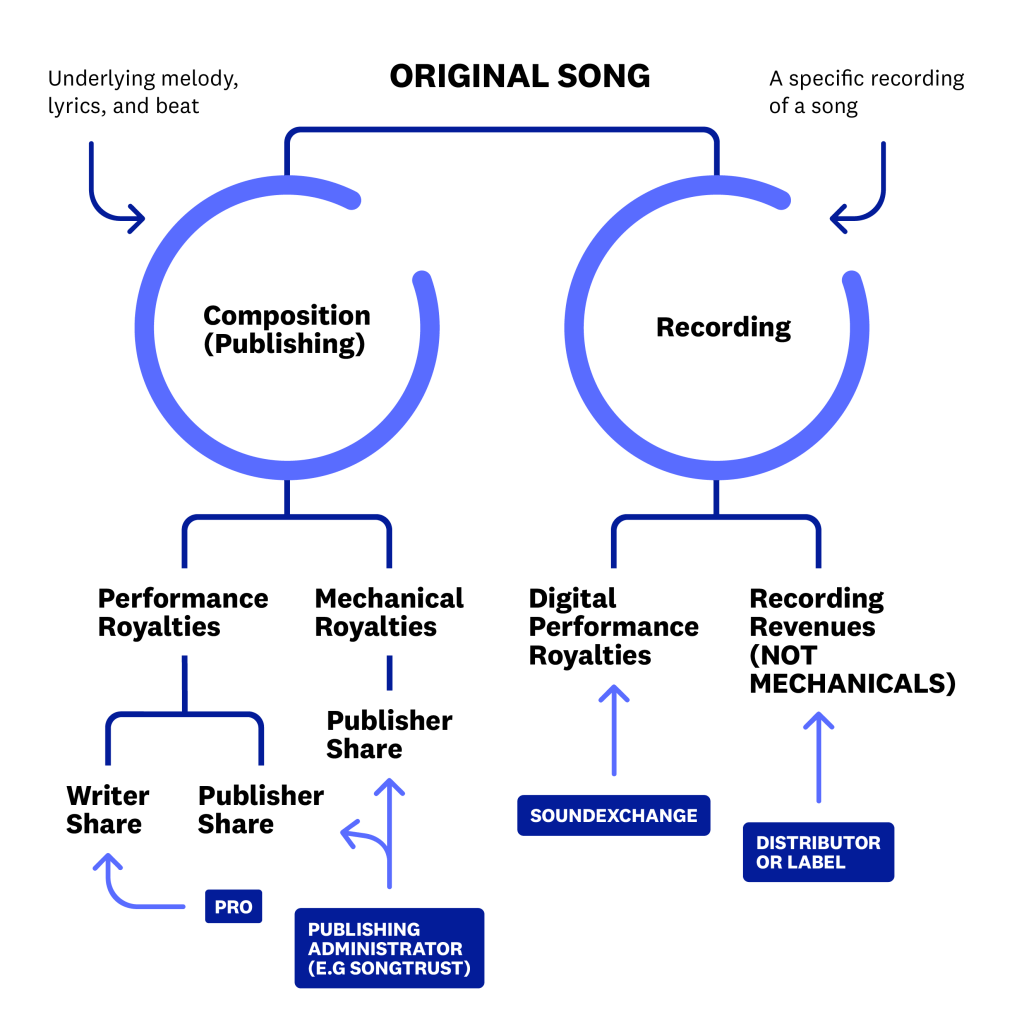
Before we continue, I want to talk about royalties. Every stream of a song triggers two separate payments. The first is the master (recording) royalty; this goes to whoever owns the recording, usually the label or distributor. The second payment is the publishing royalty, which goes to the songwriters and their publishers, and is divided into mechanical royalties for reproducing the song and performance royalties, as Indie Music Academy explains. In the United States, organizations like BMI collect performance royalties and pay songwriters and publishers. There is also no fixed per-stream rate. Ditto Music says that the pay depends on the listener’s country, whether the listener pays for a subscription, regional pricing, and the artist’s own royalty rate. So every number I provide is purely an estimate.
Wisp:
“Enough for you” is on Wisp’s debut EP Panodra, which came out through Interscope Records, according to Clash. Interscope is part of Universal Music Group, the world’s largest music company, which is publicly traded and has large investors. According to Daffodil, Spotify pays about 70% of its revenue to rights holders and an average of $0.003 to $0.005 per stream, so I used $0.004 as the average. Spotify keeps roughly 30%, publishing takes about 15%, and the label receives about 55%. If Wisp receives a typical 15% to 20% of the label share, that is only about $0.0003 to $0.0005 per stream, or roughly 30 to 50 cents per 1,000 plays. The trade-off is that having a major label brings tour support and marketing money that would be hard to fund alone.

Evanescence:
“Bring me to life” was the lead single from Fallen (2003), released by Wind-up Records. Wind-up was founded in 1997 by Alan and Diana Meltzer, was distributed by Sony, and, according to the fan wiki, sold its back catalog to The Bicycle Music Company/Concord in 2013, which now owns the band’s 2003-2011 recordings. So the money for this song now flows to a company the band does not control. So, as we can see, streaming can get confusing and messy when it comes to who gets paid. According to MuseWiki, singer Amy Lee sued Wind-up in 2014 over about $1.5 million in unpaid royalties. For the math, I’ll assume Concord is the master owner. They collect roughly 55% label share (about $0.0022 per stream), and a legacy contract gives the band around 15% of it, or roughly $0.0003 to $0.0004 per stream. The three songwriters (Lee, Ben Moody, and David Hodges) split the publishing share of about $0.0006. If you bought the song for $1.29 on iTunes instead, Apple would keep about 30%, and the artist share might be 15 to 20 cents, which is about as much as 400 or more streams.
/Gallery?file=The_open_door_2.jpg)
Cloudyfield
Cloudyfield is an artist from Aachen, Germany; she released “in your head” in February 2024 on Bandcamp, where the listing says the artist reserves all rights. A download costs €1.30 or more, and the artist can set the price. Bandcamp’s standard cut on digital sales is about 15%, plus payment-processing fees, so I estimate the artist keeps around €1.00 per download. That one sale equals roughly 500 streams of an independent song, or around 2,500 streams of a major-label artist’s share. Without a label, there’s no marketing budget, so the artist depends on word of mouth and the platform’s discovery tools.

My stance on streaming platforms in the music industry is that they have made music way more accessible to everyone; however, it’s definitely not fair to the artist. Streaming pays fractions of a cent that even big major labels earn under a dollar per 1000 plays, which makes musicians rely on tours, merch, and direct sales rather than streams. Not only that, but of course there is a monopoly, so the Big Three- Universal, Sony, and Warner own huge catalogs and negotiate directly with platforms. And it makes the music industry very saturated. I think the healthiest future combines user-centric payouts, where your money goes only to the artists you play, clearer contracts, and more direct-to-fan options. As a listener, I plan to buy music from artists I love, because for the artist, one purchase can be worth hundreds or thousands of streams.


Leave a comment